Overview of my condition on Thursday, April 6th:
I woke at 4am after going to bed around 11pm. This is much less sleep than I typically get, but I felt overall fairly balanced. I completed my morning routine and went to work. My TICs were moderate and frequent. Frequent, to me, means that I felt the urge every few minutes and manage to contain them, losing control only every 10-20 minutes or so. My most severe TICs included rolling my wrist and clenching my hand, intense face grimacing, and occasional jaw clamping.
My ankle and shoulder were fairly inactive, short of a few shoulder jolts that came about during a busy time of the day.
My least favorite TIC involves sharp repetitive inhaling and abdominal contortions that tend to leave me out of breath. Luckily, breathing related TICs were at a minimum.
I’m not used to particularly monitoring, keeping track of, or reporting my TICs, so this is a new habit for me in and of itself. I feel that it’s best, for now, that I divulge too much detail rather than too little.
My most tiring TIC was face grimacing. My eyes became tired from straining, and my face generally felt fatigued. I have to cartoonishly wiggle my face to reset myself at times and relax.
My TICs were only mildly disruptive, causing me to subtly put myself out of a customer or co-worker’s line of sight 2-4 times during the day. Sometimes this can be extremely frequent or I may need to step into the back of our store for 30-90 seconds while I let a “full cycle” of TICs pass. When I say “full cycle”, I am describing what it feels like to openly let my body TIC for a while, until my body or brain feels satisfied. I left work around 1:30pm, which is very early. My normal hours are 10am – 7pm, and I like these hours. I got home to find my Mendi had arrived.
Before my first session I sat down in my clutter-free 10×14 office, adjusted low/warm lighting, and cleared my head of distractions. I filled out a YGTSS scale to the best of my ability and judging myself from both first person and third person, I evaluated a score of 30. A score of 30, I found afterwards, is defined as “Marked” as opposed to severe. It is my understanding that YGTSS data is collected by interview or self-assessment. In any case, I am truly the best judge of this score.
Next, I proceeded to fill out a guided therapy questionnaire. I answered these both aloud and in writing.
Lastly, I chose (3) Cognitive Behavioral Therapy exercises that are designed for Tourette Syndrome patients. I spent 20 minutes on these exercises:
Technique: Deep Breathing
Demonstration: “Take slow, deep breaths in through your nose, filling your lungs completely, and then exhale slowly through your mouth. Focus on the sensation of your breath as it moves in and out, helping you relax and reduce tic severity.”
Technique: Progressive Muscle Relaxation
Demonstration: “Tense a muscle group for a few seconds and then relax it. Start with your feet and work your way up through your body, progressively relaxing each muscle group to help reduce tension and tic frequency.”
Technique: Guided Imagery
Technique: Guided Imagery
Demonstration: “Imagine a peaceful, relaxing scene, like a beach or a forest. Engage all your senses in this visualization, focusing on the sights, sounds, and sensations that bring you calmness and relaxation.”
Time to begin! I adjusted my headset for a firm but comfortable fit. I turned it on, synced with the app, and began my first session as a guest, in order to make sure everything was working correctly.
During the guest session, I scored:
33% Neural Activity, 27s of Control (Longest streak of PFC activation), and 4117p resilience.
I took a break to relax and readjust. I then began my first official session of (3).
I’ve decided that each session will consist of (3) games, for a total of 30 minutes.
DAY 1 SCORES:
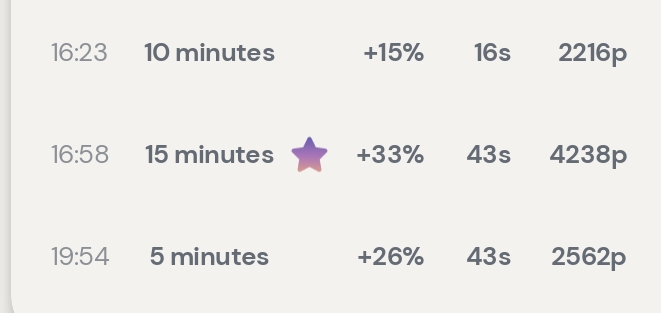
(A) 10 minute (Warm-Up) 15% 16s 2216p
(B) 15 minute (Endurance) 33% 43s 4238p
(C) 5 Minute (Cool-down) 26% 43s 2562
Best session (B):

Quick note: During Test A, I was interrupted by my cat more than once, followed by TICs that likely correlated with the frustration of my first official session being delegitimized by disruptive stimulus. Argh!! I fed the cat, even though it wasn’t dinner time, so that she would leave me alone, then proceeded to reset by repeating a CBT breathing exercise.
I have thoughts and observations to make for sure. Pardon my lack of formatting here.
I’m sure I’ll implement more structure into these reports as things move along. I may not always have as much to say.
Let me talk about the experience. Wow! I found that the Mendi was evaluating my blood oxygen levels with surprising sensitivity, as a change in neural activity was recognizable based on my breathing patterns. It truly visualizes the importance of controlled breathing habits and supplying your brain with steady, consistent oxygen. That was instantly impressive- albeit I am easily amused. However, it notably led me to consider a healthy level of skepticism- “What are we really reading here? Can we simply manipulate the results by excessively breathing?” The answer is yes and no. Breathing alone could not and did not prove effective in achieving the highest “scores”. While overall neural activity was very good while breathing excessively, my “resilience” or consistency in continuously increasing or maintaining brain activity would suffer. I made these observations within very short time periods and spent very little time experimenting with my breathing after establishing this.
I did have to remind myself though, that breathing is vital and necessary- it’s a requirement-yes-of course. Once I established calm, natural breathing pattern, I was able to enter a state of focus that led to massive acceleration of activity. I tried mixing up what I was thinking about, from the steps involved in various home improvement processes to naming the responsibilities of the pre-frontal cortex, ect. These kinds of thoughts seemed to be very stimulating, but the key appeared to be my ability to hold the thought and continue generating focused thoughts within the subjects without becoming distracted. I was able to long and hold steady elevations when I held a PARTICULAR kind of focus that I cannot fully describe yet, which was very exciting.
It’s probably critical that I do not leave this out- during the sessions I did experience TICs. I did not particularly notice how my brain activity was effected during or after a TIC. This is something I will try to pay better attention to during future sessions.
Here’s what I found most interesting and maybe I’ll be able to figure this out.. I can’t place what I was thinking about during my most successful ball runs. The moment I became overly conscious of my thought, analyze it or capture it, I would fall out of this place- the ball would follow, plummeting as I attempt to regain control.
The ball would occasionally take dramatic dives and at no point did I doubt the accuracy. I caught myself holding my breath a few times- I think for this reason I already believe this is a positive tool for guided meditation. It’s very easy for me to start holding my breath, as tensing my abdominals and unnatural breathing patterns are within the realm of my TICs. Another interesting observation I had…I would say that I can directly correlate decreased activity with my inability to find a word I’m looking for or when struggling to remember something in general. This makes sense to me, considering the PFC’s responsibilities.
That is all I have to say for now. First session interrupted, second session was under more peaceful conditions, and during the final, I began to feel a little tired. Overall, TICs aside, it’s a pretty relaxing experience. I’m enjoying it so far. I will process my thoughts and go again tomorrow!
 Neuro Journey: fNIRS for Tourette's
Leave a comment