Daily Overview: Tuesday, April 11th
I’m a busy guy. I don’t just say that- I am always on call, I work 6 days a week. Squeezing in an hour for neurofeedback training every day is no easy feat!
Life gets busy. The beauty of what I’m doing here, to me, is the flexibility that comes with not being bound to strict supervisory rules. Although I’m conducting this study with as many controls as possible, I’m also including your average, every day distractors as factored conditions. If you’re also someone who is always on the go, you can appreciate the value of being able to train your brain whenever it’s convenient for you. Whether it’s early in the morning, late at night, or during a lunch break, you have the freedom to fit your training into your schedule. Although most of my sessions have fallen near the end of the day, some have been in the afternoon, and that’s ok. Why should I implement barriers so stringent that no one could ever hope to mirror my efforts? I want to train my brain to focus under ever the stress and duress of everyday conditions, because that is when any resulting benefits will be useful.
Moreover, for individuals who have Tourette syndrome, this approach to brain training makes sense. If you live in California, you can drive to an expensive Brain Training Center 3 times a week and utilize neurofeedback therapy under controlled conditions, but this doesn’t make sense to me for my purposes. The daily stresses and distractions of life can trigger tics- we should be learning how to gain control when outside factors are throwing us off- that’s when it’s important.
By the way…I’m NOT discouraging ANYONE from seeking professional help and I am not anti-doctor by any means. I see a regular doctor. Maybe I should have mentioned this sooner, so that I’m not discouraging other’s from getting professional help for their problems. Well, I’ve said it now. Don’t ignore your mind and body- seek professionals!
Anyway, with limited free time, I understand the importance of maximizing every moment to get the most out of your day. Home-based brain training can be completed in short intervals, making it easy to fit into even the busiest of schedules. This means that individuals with Tourette syndrome can train their brains and improve their symptoms without sacrificing their other commitments or disrupting their daily routine. If you have Tourette Syndrome, you may likely have OCD like I do, and therefor understand all too well that disruption in your routines can create energy-draining frustration.
Today, I self-conducted psychotherapy, using three techniques and a answered a question for each technique.
- Habit Reversal Training (HRT):
HRT involves identifying the urge that precedes a tic and replacing it with a competing response. If the urge is to blink excessively, for example, the competing response might be to focus on relaxing the eye muscles instead.
Question: Can you describe a time when you successfully used your competing response to manage your tic? What was that experience like for you?
- Exposure and Response Prevention (ERP):
ERP involves gradually exposing the person to situations that trigger their tics and teaching them to resist the urge to perform the tic. Over time, the person learns to better manage their tics in real-life situations.
Question: What is one situation that you currently avoid because it triggers your tics? How would it feel to be able to face that situation and manage your tics effectively?
- Comprehensive Behavioral Intervention (CBIT):
CBIT combines HRT and ERP, as well as other strategies such as relaxation training and social support. It is a structured, multi-component intervention designed to help people manage their tics and improve their quality of life.
Question: Which component of CBIT do you find the most helpful? How have you incorporated that into your daily life, and what improvements have you noticed as a result?
Now I will lightly recap today’s disastrous attempt to start my session. I got home from work early, showered, got through the psychotherapy questions, and proceeded to be continuously interrupted FOUR TIMES before I could finally start my session. When I was FINALLY ready to begin…my headset had low battery. (lol)
I listened to music and made an effort to practice progressive muscle relaxation until we had enough charge. This consists of tensing and then relaxing different muscle groups in the body. It helped release tension. A few lazy couch stretches too.
YGTSS SCORE: 40
DAY 6 SCORES:

BEST SCORE: (A)
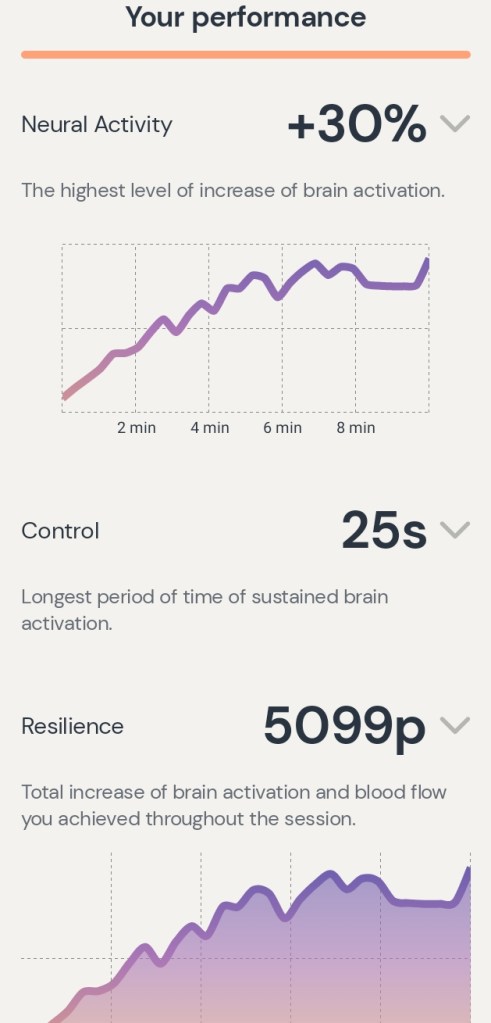
I don’t know what the hell happened on game (C), but my overall activity and resilience has shown phenomenal, consistent improvement, demonstrated in games (A) and (B). I am slowly learning how to “lock in” once I’ve achieved a flow-state. It’s VERY challenging sometimes to maintain a steady breathing pattern. Put simply, when I realize I’ve deviated from a healthy breathing pattern, I try to adjust, my flow-state is broken, the ball temporarily plummets and I have to quickly try and recover. It’s an interesting dilemma and as of today, my number one challenge has become breaking this breathing/focus barrier.
In reference to the title of today’s entry, I decided to finally research the potential risks of excessive neurofeedback training. I found that POTENTIAL SIDE EFFECTS INCLUDE: Nausea, headaches, irritability, brain fog, confusion, sleep disturbances, and…wait for it…TICS?! Well, now we know. That’s why it is critical you don’t sit around all day plugging into this kind of thing. I did NOT research the side effects before this study, as I wanted to enter this experiment without any negative pre-established afflictions. Now that I’ve gotten comfortable with it, I felt it now was appropriate. I will keep these potential side effects in mind and monitor myself closely. I am very confident I will recognize the difference between provoked stress and unusual, inorganic changes in behavior.
That being said, Neurofeedback Training effects everyone very differently many factors are to be considered. If anyone reading is considering this, my experience so far has made me want to feel it out and adjust as necessary as I go along. There will be right and wrong ways to approach training for everyone.
Over the next few months, you can expect me to tweak and change things within reason. One thing I am considering for tomorrow’s session came about from a suggestion from a friend: “Wouldn’t you be able to better compare your performance within a session if all games were 10 minutes long, instead of 10, 15, and 5?”
I was admittedly concerned about this and mentioned it in an earlier report.
So tomorrow, I will move forward with (3) 10 minute sessions. That’s it for today.

 Neuro Journey: fNIRS for Tourette's
Leave a comment