Overview:
Friday May 12th and Monday May 15th
Today is Tuesday.
I don’t have a rhyme or reason for updating you today rather than the end of the week- but I do have some updates and observations.
I have only trained for 4 out of 16 days in May so far. OUCH!
“What have you been up to and how are your tics?”
I have been working 60 hours a week and the details of 30+ installations have been rattling around in my brain like a trapped hornet when I put my head on my pillow at night.
I’m getting home late and my days are packed. It’s that simple really. Self preservation is not optional if I want to avoid burn-out.
9:00pm customer calls, last minute order alteration requests, optimizing a schedule for 4 different contractors, claims, updates, you name it.
ZERO operational failures, order missteps, or installation issues in at least two months– but enough about work.
As of yesterday, I made a major change to my evening routine that should get me back on track with training.
TICS. Today? YGTSS SCORE: 13
New reader? That’s the Yale Global Tic Severity Scale. I do not include this on every report anymore. The YGTSS is a simple but thorough evaluation checklist that ranks frequency, severity, and how disruptive tics were during a patient’s day.
I have no doubt that by whatever means this training is achieving the results, a correlation is now forming with strength. Maybe it’s the meditative nature of training that has been helpful or maybe I am simply strengthening my PFC, leading to direct impulse control.
In any case, I have lacked consistency in the month of May. I can’t boldly tell you there is, for certain, a direct correlation but…
I have uncontrollably clenched my right hand and rolled my wrist while preforming certain tasks over the past 4-6 days.
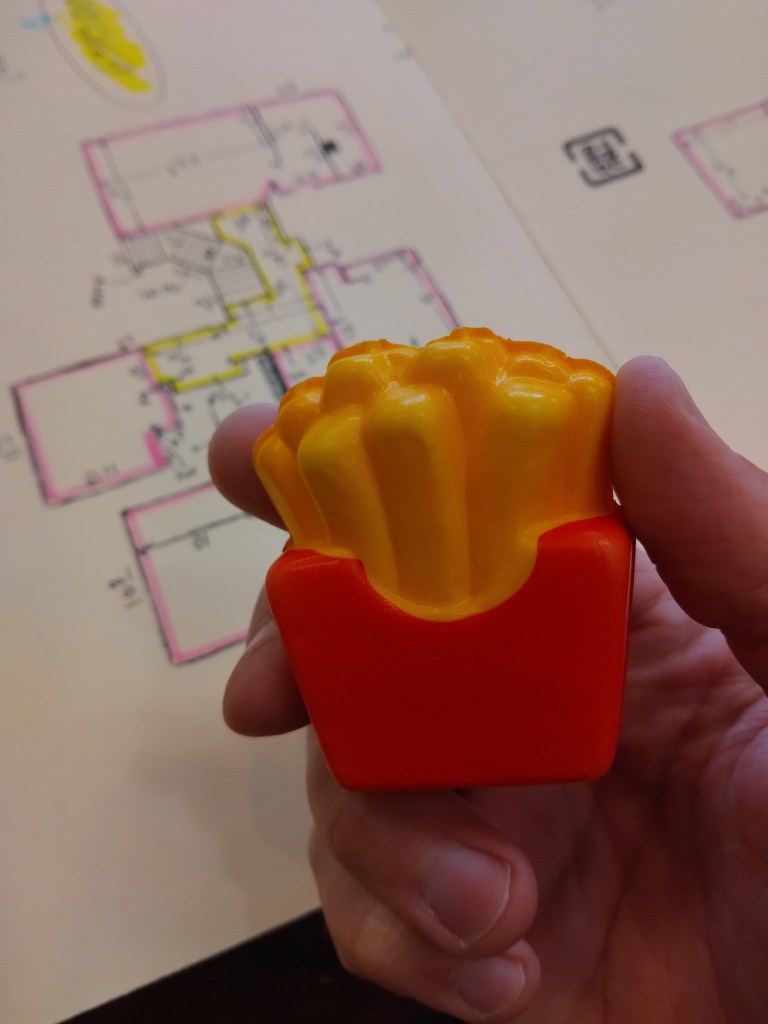
Luckily, our 6 year old loves to give me gifts. He really came through in the clutch recently with this squishy french fry stress toy. I have many hand-training/hand relief devices but I enjoy the sentiment of it and I smile every time I rediscover it in my desk drawer.
As you will observe by my most recent scores, a lack of consistency has made a major impact on PFC activation!
I was going absolutely gangbusters for a while there, nearing or breaching 100% activation on a consistent basis.
We can now observe, in a measurable way, the importance of training consistency, how long the effects of neurofeedback training may last after halting sessions, and how quickly progress can unravel as a result.
LAST REPORT: MAY 9TH
(2) LATEST SESSIONS BELOW:

There aren’t many other challenges I’ve accepted in life that I could say were more “mind over matter” than this one. I feel a mental block forming as I continue to miss sessions and potentially a lack of confidence when entering the session.
Conscious control of the PFC is a skill that seems very easy to “forget” or lose a sense of.
After a breach in consistency:
Activation: Noticably lower
Control: Varied
Resilience: Considerably high
This is interesting and leads me to wonder which metric is the leading critical indicator of a well-trained PFC, but I’d be willing to go out on a limb a say activation is likely it. 🤷♂️
“Your study is bananas! Question about tics. If it was life or death, could you NOT tic if you tried REALLY hard? How does that work? Can you describe this to someone who doesn’t understand?”
I thought of a comparison to answer this question. If you had a slight, almost negligible itch, you will likely resist scratching it while politely listening to someone, or wait for an opportune moment to scratch the itch.
If you had a REALLY aggressive, nearly painful itch, you’re probably going to do what you have to do or find an excuse to step away.
For me, the “smaller” the tic, or the less energy it requires, the harder it is to control. Violently jolting my right shoulder up and down or in circular motion, for instance, requires a lot of energy.
It’s a larger and more demanding action compared to that of my least favorite tic: Clenching my fist or rolling my wrist. The quicker and less energy is required, the harder it is to control.
At times I can NOT stop my fist from clenching or my face from grimacing (minor motor) because it happens too quickly for me to actively stop it before it has started and finished.
I hope that makes sense. It’s like the difference between doing a jumping jack and blinking. One is much easier to execute, and thus circumvents my control momentarily.
That’s it for today! I’m really going to try to keep a streak going and get back on track.
Thanks for reading. Very cool of you.
Please share my case study with anyone you like- or others with TS.

 Neuro Journey: fNIRS for Tourette's
Leave a comment